
Outstanding Warrants in Honolulu County
Honolulu County posts no single search that lists every outstanding warrant, so the answer arrives in pieces. The Hawaiʻi Judiciary's eCourt Kōkua system gives the public case summaries and docket events, which is where most warrant clues surface. HPD's Records & Identification Warrants Unit processes certain paper warrants and answers authorized record questions. The Hawaiʻi Department of Law Enforcement Sheriff Division serves court process and executes arrest warrants. Each channel holds only its own part of the picture, so a thorough Honolulu County warrant check may require more than one call. Worth understanding what "active" actually means here. A warrant stays outstanding until the issuing authority recalls it, cancels it, serves it, or otherwise closes the process. But the labels can mislead you. A case marked ACTIVE is not automatic proof of an active warrant, and a case marked INACTIVE or CLOSED may still contain an outstanding order or sanction. The event history, checked against the issuing clerk's current record, is what settles the question.
No Honolulu County Active Warrant Roster
Honolulu County simply has no complete public roster of active warrants, and that fact shapes every search. HPD's Wanted Persons page, also called Na Maka, is curated rather than complete. The Judiciary's eCourt portal is a case-information system, not a warrant database. eBench exists, but only authorized law enforcement can use it. The DLE Sheriff Division offers service and public-record channels, not a statewide public warrant search.
Plain answer: No result on an official public page does not prove that no Honolulu County warrant exists.
Treat the public tools as leads, not verdicts. Confirm any apparent active event with the First Circuit court named in the case, or ask the responsible Honolulu County agency what it can lawfully release.
The Honolulu County Active Warrant List
With no single list to consult, a Honolulu County active-warrant check works as a chain of steps. Begin at eCourt Kōkua, ideally with the Case ID in hand. Look over the court, location, status, last update, Events, Dockets, Offenses, and Bail/Bond Information fields. Search by legal name only when you lack the identifier, and compare enough case facts to rule out a false match. Then pick up the phone. Circuit Court matters go to the First Circuit Legal Documents Branch, district criminal matters go to Legal Documents Branch 2, and traffic questions go to the Traffic Violations Bureau or the rural District Court division. HPD's Records & Identification Warrants Unit can be reached at (808) 723-3258 for HPD-held information. Questions about sheriff service start with DLE Oʻahu Section at (808) 587-5002.
Honolulu County Active Warrant Confirmation
HPD's official warrant policy explains why a public case screen in Honolulu County can never substitute for agency confirmation.
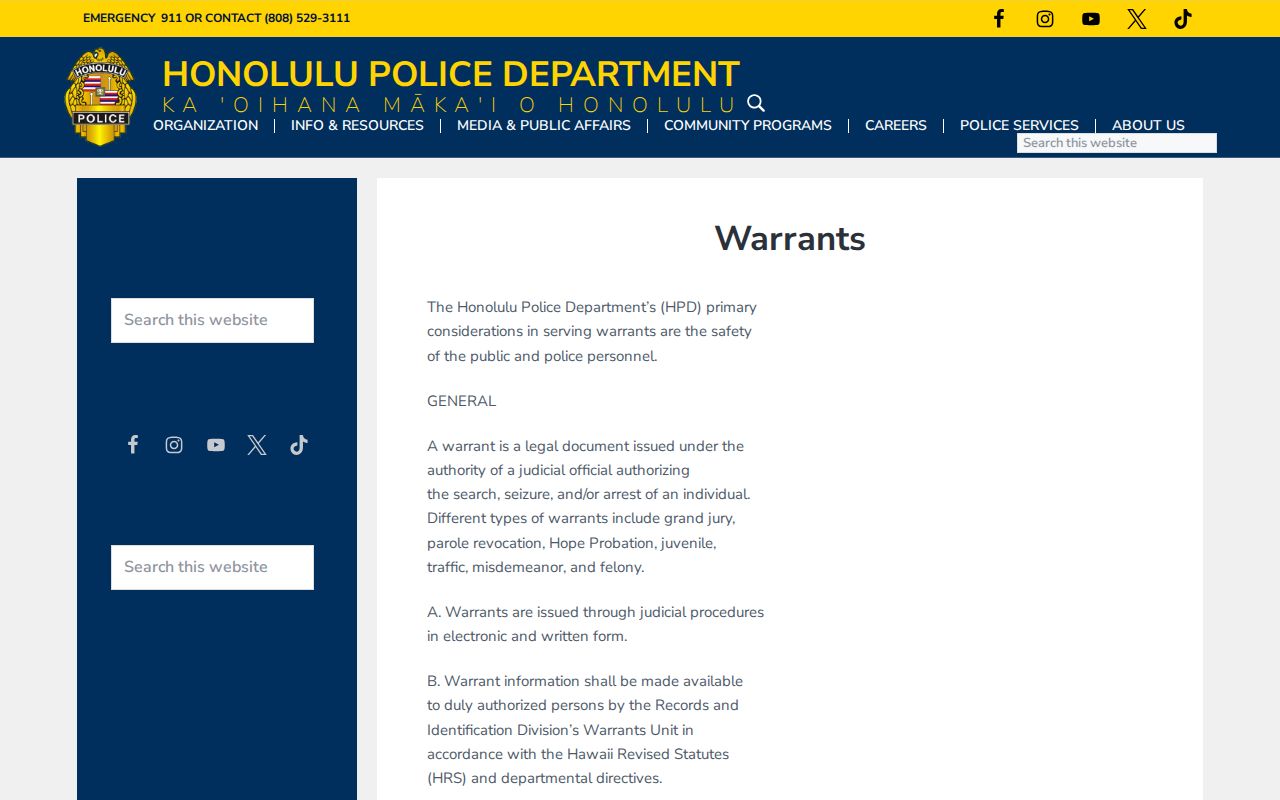
The policy requires officers to confirm a warrant through Communications before acting on it. Depending on the warrant, that confirmation may involve eBench, an investigator, the Sheriff Division, a neighbor-island agency, or NCIC. Those are operational channels, not public search products. For paper warrants processed by the Warrants Unit, HPD assigns a warrant number, enters the record, retains the original, sends a service copy to the responsible element, and periodically validates it. After service, the officer completes the return paperwork and sends the original back to the issuing authority. That workflow explains why Honolulu County court files, police records, and service records can each show a different slice of one matter.
Active Warrants: What They Show
A public Honolulu County case record may show enough to locate the issuing office but hide internal status fields. Read each field within its own source and date. A warrant document can also be absent from public view even when a docket event is visible.
| Case ID | The Judiciary identifier used to reach the correct file |
|---|---|
| Court and Division | Circuit, District, Family, traffic, or another issuing authority |
| Warrant Type | Felony, misdemeanor, traffic, bench, parole, or another source label |
| Issue and Event Dates | Dates for filing, FTA, issue, recall, service, or disposition when public |
| Status | Active, recalled, canceled, executed, served, or unserved where the record uses that term |
| Bail/Bond | Case-specific information, not a countywide standard amount |
| Document Access | A PDF icon may offer a public copy; the clerk is the fallback when it does not |
Honolulu County Active Warrant Status Codes
eCourt uses codes that surface in warrant-related events across Honolulu County dockets. FTA means Failed to Appear. PCAW means Probable Cause to Issue Arrest Warrant, JDPC means Judicial Determination of Probable Cause, and CBF means Court Bail Forfeited. An INACTIVE case can still reflect an FTA and bench-warrant posture, though the label alone never tells you whether the warrant was later recalled or served.
- Active case
- An ongoing court case, which is not the same as a verified active warrant.
- Recall
- A court action withdrawing a bench warrant or setting a new date; a filed request alone is not an order.
- Served or executed
- Law-enforcement action completed on the warrant, followed by return paperwork.
- Unserved
- No completed service shown in that record; it does not mean canceled or expired.
Honolulu County Warrant Roundups
Honolulu County runs no countywide warrant-roundup week and no blanket amnesty. What it offers instead is targeted court access. Community Outreach Court is a mobile First Circuit program for eligible people facing nonviolent, nonfelony quality-of-life cases who are homeless or at risk of homelessness. Participation is voluntary, requires a referral, and does not cover every warrant type. The official Community Outreach Court page lays out eligibility and the rural Oʻahu sites.
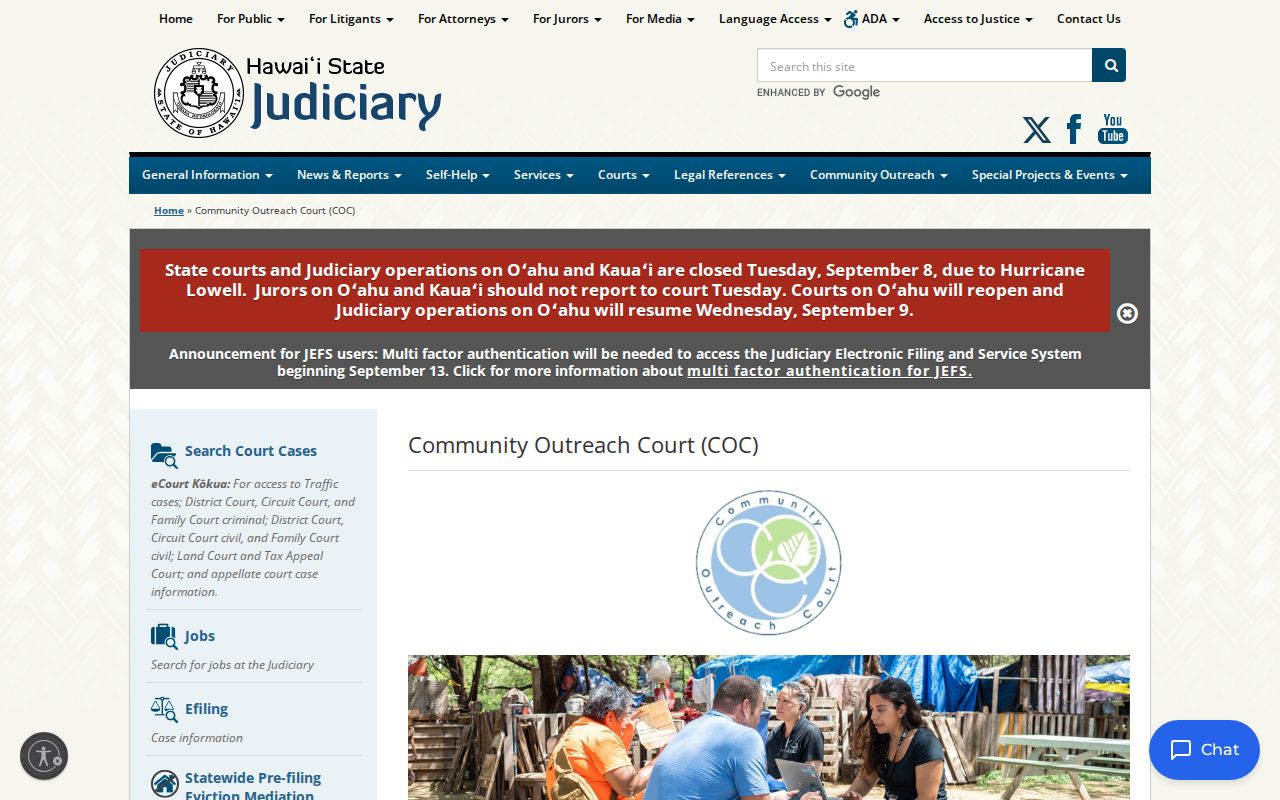
The program's reported outcomes run from January 2017 through July 2025. In that span, 706 participants completed it, 10,699 cases were cleared, 955 bench warrants were recalled, and 7,697 license stoppers were lifted. Those totals show scale in Honolulu County, never a promise that a given case qualifies.
Honolulu County Outstanding Warrant Posts
HPD's Wanted Persons program, also known as Na Maka, asks the public for tips on selected matters. It does not represent all outstanding Honolulu County warrants, and someone left off the page may still have a court issue pending. Use the official HPD program page for current agency material. The program itself shows the gap between a public assistance bulletin and an actual warrant database.
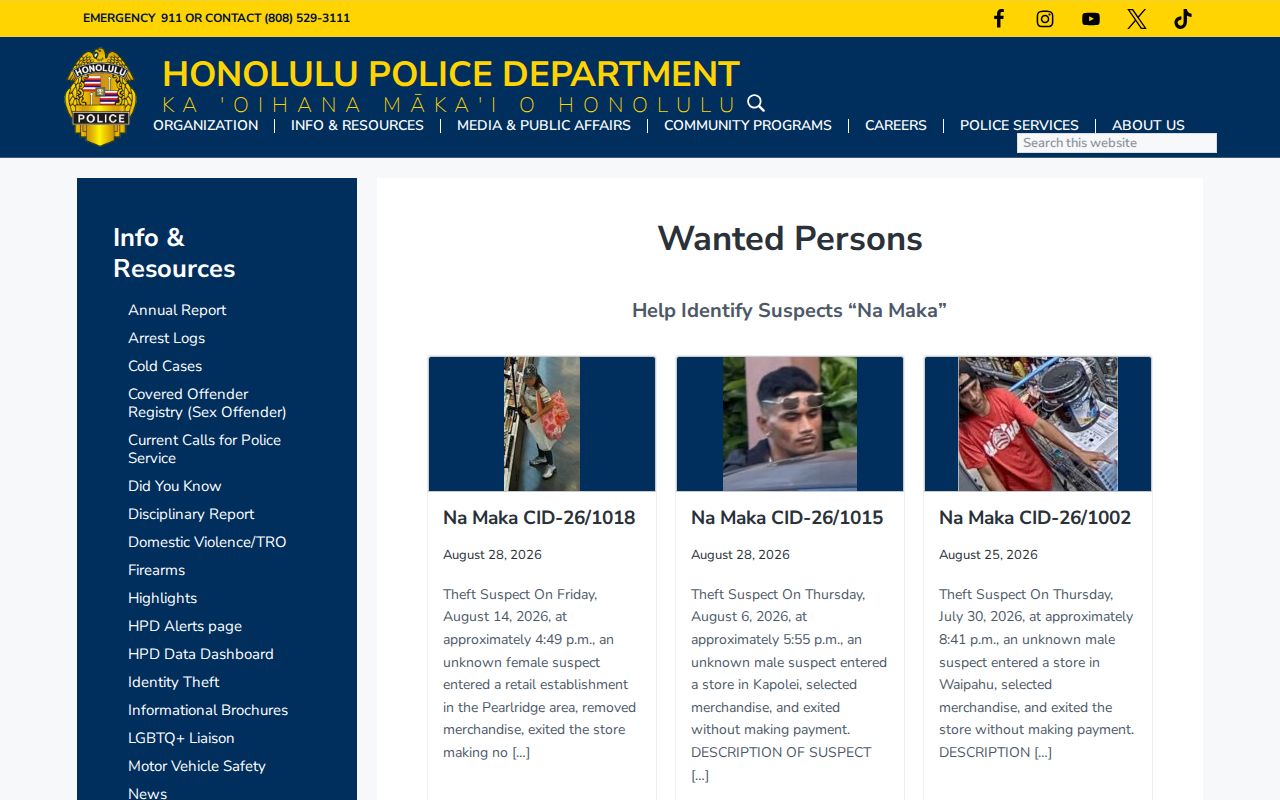
Honolulu County tips go to CrimeStoppers. A question about your own warrant belongs with the issuing court, HPD Records, or the Sheriff Division.
Finding Your Own Name on the List
A wanted post, a case result, or a caller's claim is never the last word. Write down the official source and case identifier. Then call a lawyer or the Honolulu County court that issued the warrant. Ask whether it is still current, what case it belongs to, and whether an appearance or motion is required. Also ask how to obtain a signed recall order or a new date.
- Save the official case ID, court, location, and last-updated date.
- Use the phone number from the Judiciary, HPD, or DLE official site, not from an incoming call.
- Ask the clerk what the latest warrant-related event means and whether a document is available.
- Consult counsel about surrender, appearance, bond, or a motion before visiting a police office.
Caution: Never send gift cards, cryptocurrency, wires, Cash App, or Venmo to a caller claiming immediate warrant payment is required.
Honolulu County Active Warrant Record Fallbacks
No PDF from eCourt? Then use the Oʻahu court-record request route instead. A strong Honolulu County request names the case type, the Case ID, the party names, and the exact document you want. Plan on about ten business days for ordinary requests. Mail takes longer, and newly filed records may need at least three business days before processing begins. Sheriff Division material follows a different path. Ask the DLE in writing, under the Hawaiʻi Uniform Information Practices Act. Privacy rules, active-law-enforcement exemptions, court orders, and juvenile confidentiality can each limit what gets released. HPD holds its own files, and Records & Identification decides what an authorized requester may see. None of these routes is a live Honolulu County warrant roster. The case decides the court. Circuit Court at 777 Punchbowl Street takes felony trials and higher-level matters. District Court and TVB at 1111 Alakea Street handle many misdemeanor, ordinance, and traffic files. Divisions in ʻEwa–Pearl City, Kāneʻohe, Wahiawā, and Waiʻanae/Kapolei serve the rest of Oʻahu. Family Court juvenile records stay restricted. Honolulu County has many courthouses, so use the court and location printed in eCourt rather than the nearest building. Federal cases sit outside this chain. PACER and the District of Hawaiʻi Clerk at the federal courthouse offer public docket access. A sealed federal warrant may still not appear. Neither PACER nor eCourt lists every outstanding warrant. In every jurisdiction the goal is the same: find the authoritative case office and ask a narrow status question tied to a real case identifier.