
Honolulu County Warrant Searches
Start with the Hawaiʻi Judiciary's eCourt Kōkua portal. It covers First Circuit traffic and District, Circuit, and Family Court case information. It is not an active-warrant database, though. A case number gives the cleanest route in. When the number is unknown, a legal-name search helps, but the Judiciary cautions that a name match alone proves nothing about identity. A thorough Honolulu County warrant check follows the record from public case information to whichever office can actually confirm it, whether for your own matter or one you are authorized to address.
- Search eCourt Kōkua by case ID when known, or use the party-name fields and narrow the result by filing dates and case type.
- Open the case summary and read the court, location, status, last-updated date, Events, Dockets, Offenses, and Bail/Bond Information.
- Call the listed First Circuit clerk or Traffic Violations Bureau to ask what an FTA, bench-warrant, recall, or probable-cause event currently means.
- For an HPD record, contact Records & Identification's Warrants Unit at (808) 723-3258. For sheriff service records, contact the DLE Sheriff Division or submit a UIPA request.
- Use PACER and the District of Hawaiʻi Clerk only when the matter is federal. Hawaiʻi eCourt does not cover federal cases.
Honolulu County Warrant Check Systems
Honolulu County warrant records live in very different systems. eCourt Kōkua is the Judiciary's public case-information route. eBench is something else entirely. Under HPD policy it is a HIJIS electronic bench-warrant channel open only to authorized law enforcement, so the public cannot log in, and HPD posts no public warrant search roster either. That split matters. An event on eCourt is not the same as an officer's current confirmation, which HPD officers obtain through Communications, eBench, investigators, the Sheriff Division, a neighbor-island agency, or NCIC as the situation requires. A member of the public with a matching event should take it to the issuing clerk. The official eCourt guidance notes that records appear only after court staff update them and that some documents never go online. The Judiciary's records page lays out the public entry point and the case types it covers.
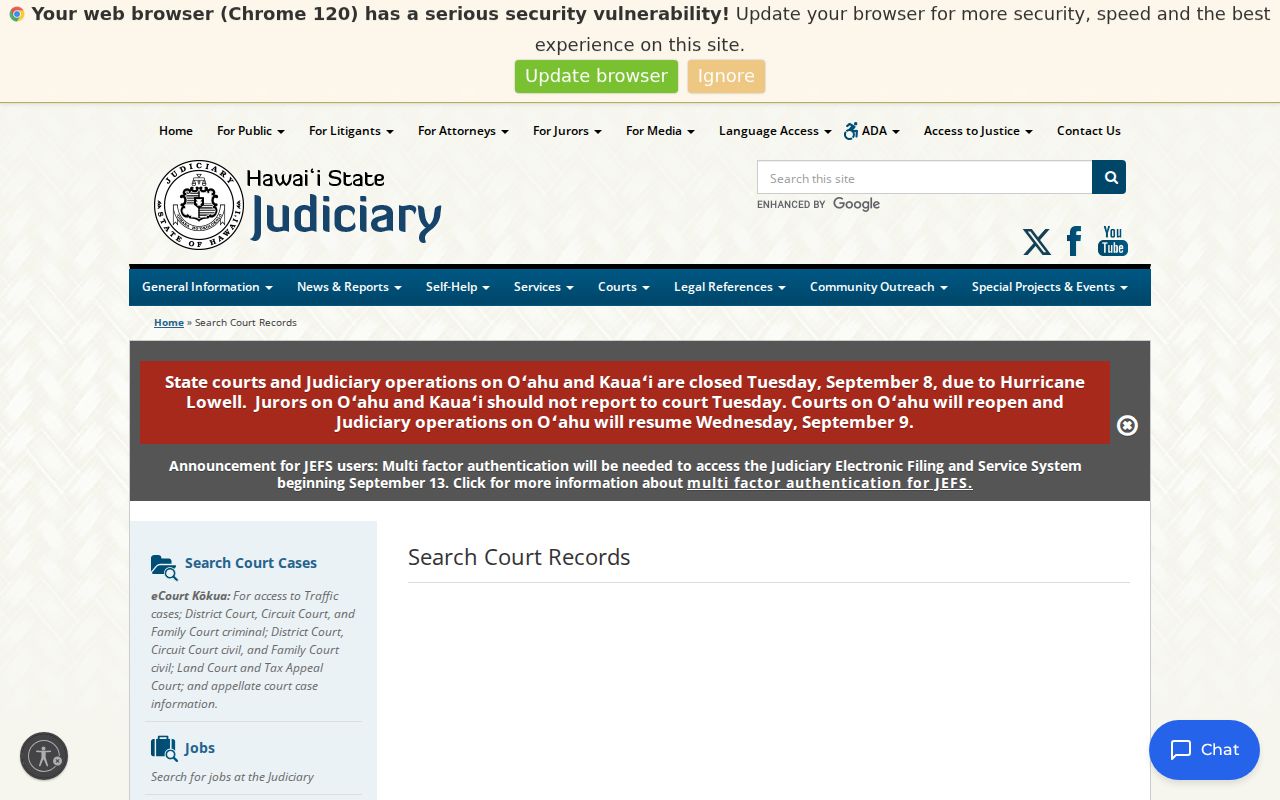
This official Honolulu County screen points readers to the court system first, not to a people-search service.
What a Warrant Search Asks For
The current eCourt interface offers several routes. A Name Search needs a last and first name. Middle name, phonetic and partial options, filing dates, and case type can narrow the results. Case Search is stronger when a known identifier is in hand. Vehicle fields find related court cases, but they do not create a Honolulu County warrant or driving-history search.
| Field Label | Type | Required | Notes |
|---|---|---|---|
| Last Name | Text | Yes | Exact, partial, or phonetic choices can change the result set |
| First Name | Text | Yes | Compare other case facts before treating a match as yours |
| Middle Name | Text | No | Useful for reducing common-name collisions |
| Filing Dates | Date range | No | Narrows cases by when the file began |
| Case ID | Text | Yes for Case Search | May be paired with arrest number, OTN, SID, or TCT number |
| Case Type | Select | No | Separates traffic, criminal, civil, and other case classes |
Honolulu County Warrant Search Friction
A Honolulu County warrant search can throw a lot at you. One broad query may return up to 200 results, and only 20 show per page until you hit Load More. Partial or phonetic search helps when the spelling is fuzzy. The trade-off is more ambiguity. Before calling the clerk, weigh the court location, the filing date, the case type, the party role, and any case history you already know.
Quick check: A matching name does not establish identity or current warrant status. Use the Case ID and issuing court to verify the record.
New traffic citations can take 13 days or more to appear. A silent Honolulu County search may reflect a sealed, juvenile, or confidential file. Given timing and access limits, following up with the clerk is part of the process, not an optional extra.
Honolulu County Warrant Search Results
A case summary shows the court and events that trace a Honolulu County warrant question. Read it as a timeline. ACTIVE means a case is ongoing. INACTIVE can mean no further step will occur until another event, and the Judiciary itself gives an FTA and bench warrant as one example. A closed or adjudicated case may still carry an outstanding order or sanction.
| Case ID | A court identifier such as the Judiciary's sample 1CPC-17-1, never a live person's number |
|---|---|
| Court and Location | The First Circuit court and division responsible for the file |
| Events and Dockets | Entries that may show FTA, probable cause, issue, recall, service, or disposition |
| Offense | The charge or citation tied to the case, when public |
| Bail/Bond | Case-specific information when the public summary contains it |
| Document Access | A PDF icon marks a purchasable public document; no icon means use the clerk |
Honolulu County Warrant Search Codes
Short codes point toward the right question. FTA means Failed to Appear. PCAW means Probable Cause to Issue Arrest Warrant. JDPC means Judicial Determination of Probable Cause. CBF denotes Court Bail Forfeited, and OSEL indicates an order sealed and confidential. These labels describe events or status inside a Honolulu County file; they do not independently confirm that a warrant remains enforceable today. The Judiciary's official code reference holds the source definitions.
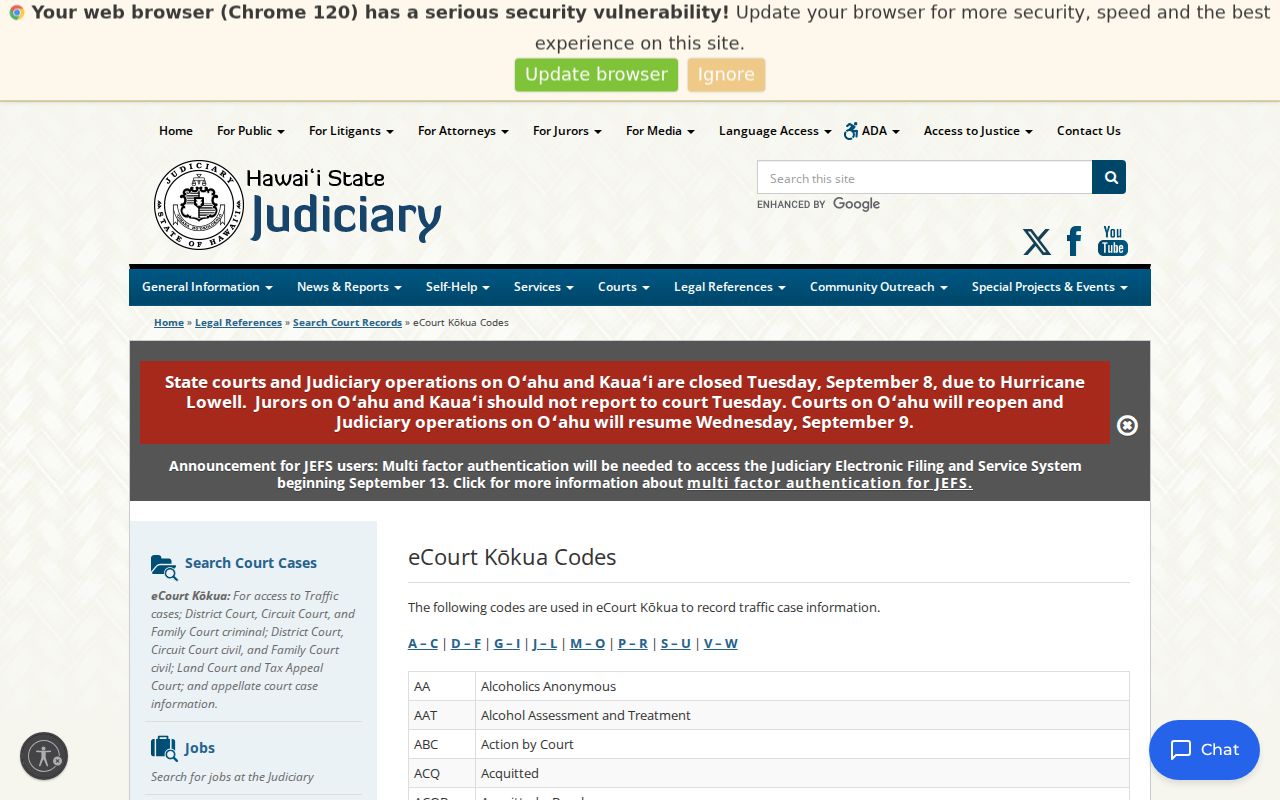
The code list works best beside the full event history and a Honolulu County clerk's current explanation.
Honolulu County Warrants: Who Holds What
The Hawaiʻi State Judiciary First Circuit is the core court system on Oʻahu. Circuit Court handles felony trials and higher-level matters. District Court takes traffic, ordinance violations, misdemeanors, and probable-cause work. Family Court sits as a Circuit division, and juvenile material is restricted. Honolulu County has no separate municipal court or county clerk for ordinary criminal and traffic warrants. When online documents are missing, the Oʻahu court-record request page routes Circuit and Family requests to the Circuit Legal Documents Branch, District matters to Legal Documents Branch 2, and traffic questions to TVB. HPD Records & Identification answers HPD warrant-record questions. The DLE Sheriff Division serves court process and arrest warrants, with the Oʻahu Section at (808) 587-5002, Circuit Court Sheriff at (808) 539-4599, and District Court Sheriff at (808) 538-5696.
When a Honolulu County Warrant Check Is Silent
A dead link or an empty result does not end a Honolulu County warrant check. Ask the court's records section next. Put the court, case type, case ID, party names, and the document you want in one written request. Newly filed material may need at least three business days. A standard request takes about ten business days. Mailed copies run slower, and the clerk may invoice search or copy fees, so do not send cash with a form. For sheriff records, the path differs. Honolulu County sheriff records follow the Hawaiʻi Uniform Information Practices Act, and the official DLE UIPA instructions ask for a reasonable record description, contact information, and a delivery preference.
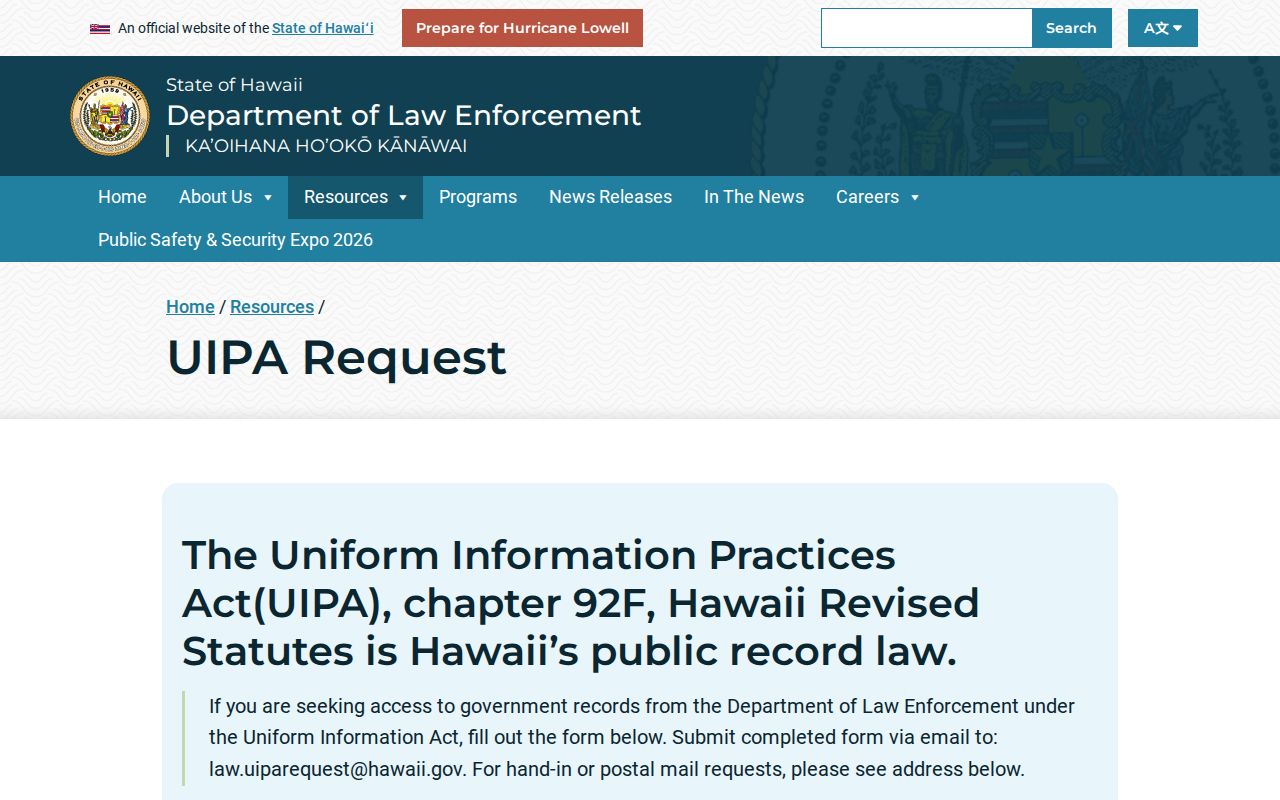
A UIPA request only asks an agency for its Honolulu County records; it does not confirm a live warrant and remains subject to privacy and law-enforcement exceptions.
Which Warrants Stay Restricted
Hawaiʻi's Uniform Information Practices Act opens government records unless an exception applies. Warrant material is not one uniform class. A Honolulu County docket, warrant document, service return, active investigative file, and juvenile record can each come out differently. Court rules and confidentiality statutes govern judicial files too.
Key rules:
Sealed or confidential documents are not shown through the public eCourt interface.
Juvenile warrant information is restricted and cannot be replaced with an adult name search.
Absence from eCourt is not proof that no warrant exists, and an event is not police confirmation.
Verify Honolulu County Warrant Check Calls
Scammers work the Honolulu County warrant angle by phone. HPD's June 2026 alert describes callers claiming a missed jury duty or an active warrant, then demanding money or personal information. Real court notices come by mail. Immediate payment demands are the tell. The agencies warn against gift cards, wire services, cryptocurrency, Cash App, or Venmo, and the HPD warning lays out the local fraud pattern.
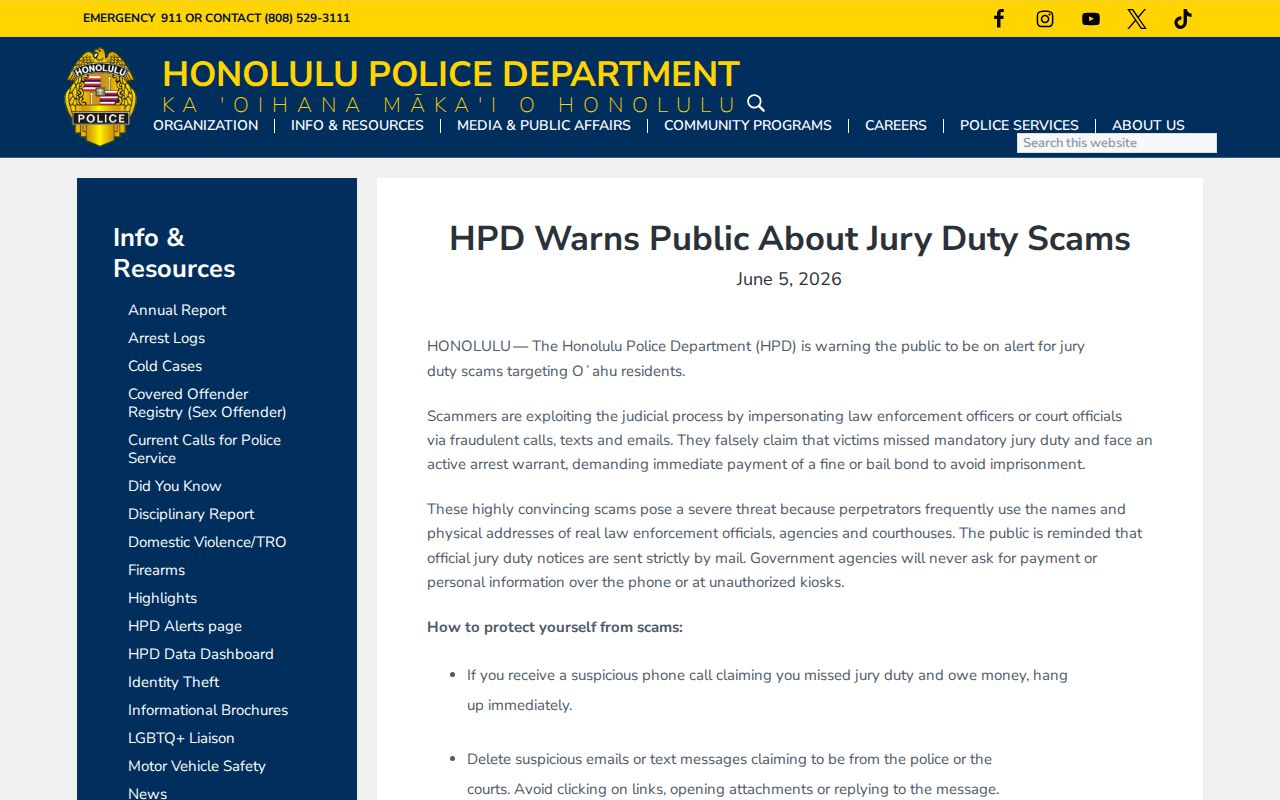
Look up the agency's published number yourself. Never use the number a caller gives you. A genuine Honolulu County warrant question ties back to a court, a Case ID, and a public agency contact you can check on your own. Ask the issuing clerk or HPD Records whether the case details are real. That independent check beats any phone demand. If the matter is urgent, consult counsel about the safest lawful response instead of negotiating with a stranger.